
Audit Overview
Your store's untapped revenue potential — and how to unlock it
Why We Created This Audit
We analyzed aptronixindia.com the same way we've audited 350+ e-commerce stores — looking for the specific gaps between your current experience and what top-performing Electronics stores deliver. Every finding in this report is a revenue opportunity backed by industry data and competitive benchmarks.
What We Analyzed
- UX & Conversion Design12 findings
- Technology & App StackPlatform + 4 apps
- Industry BenchmarksElectronics
Pages Analyzed
- Homepage3 findings
- Collection Pages3 findings
- Product Pages (PDP)4 findings
- Cart & Checkout2 findings
 This audit was prepared by Growisto — a CRO-led Website development team behind 167% conversion growth for Atomberg, 46% CR lift for TyresNmore, and 350+ e-commerce projects.
UX & Conversion Findings
Page-by-page analysis with visual comparisons against top Electronics stores
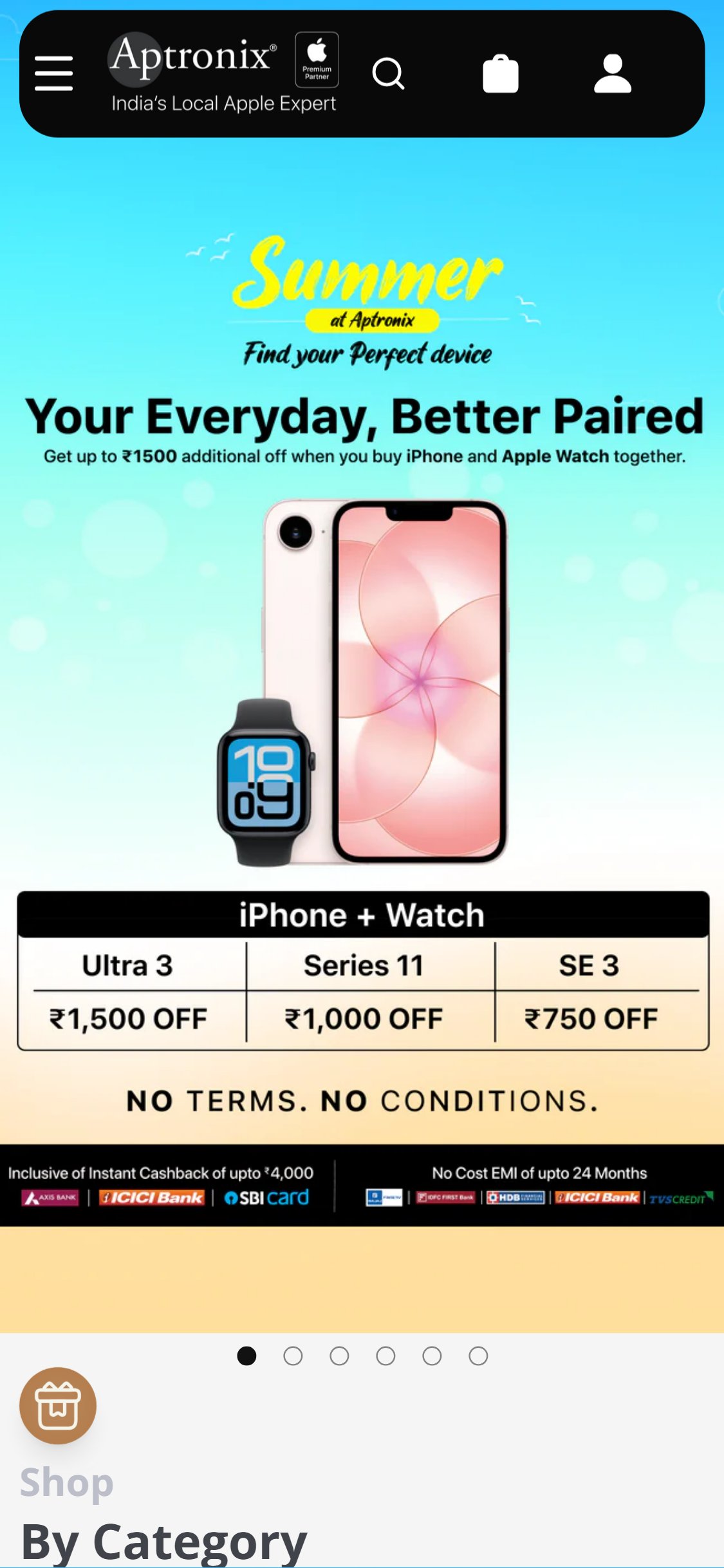
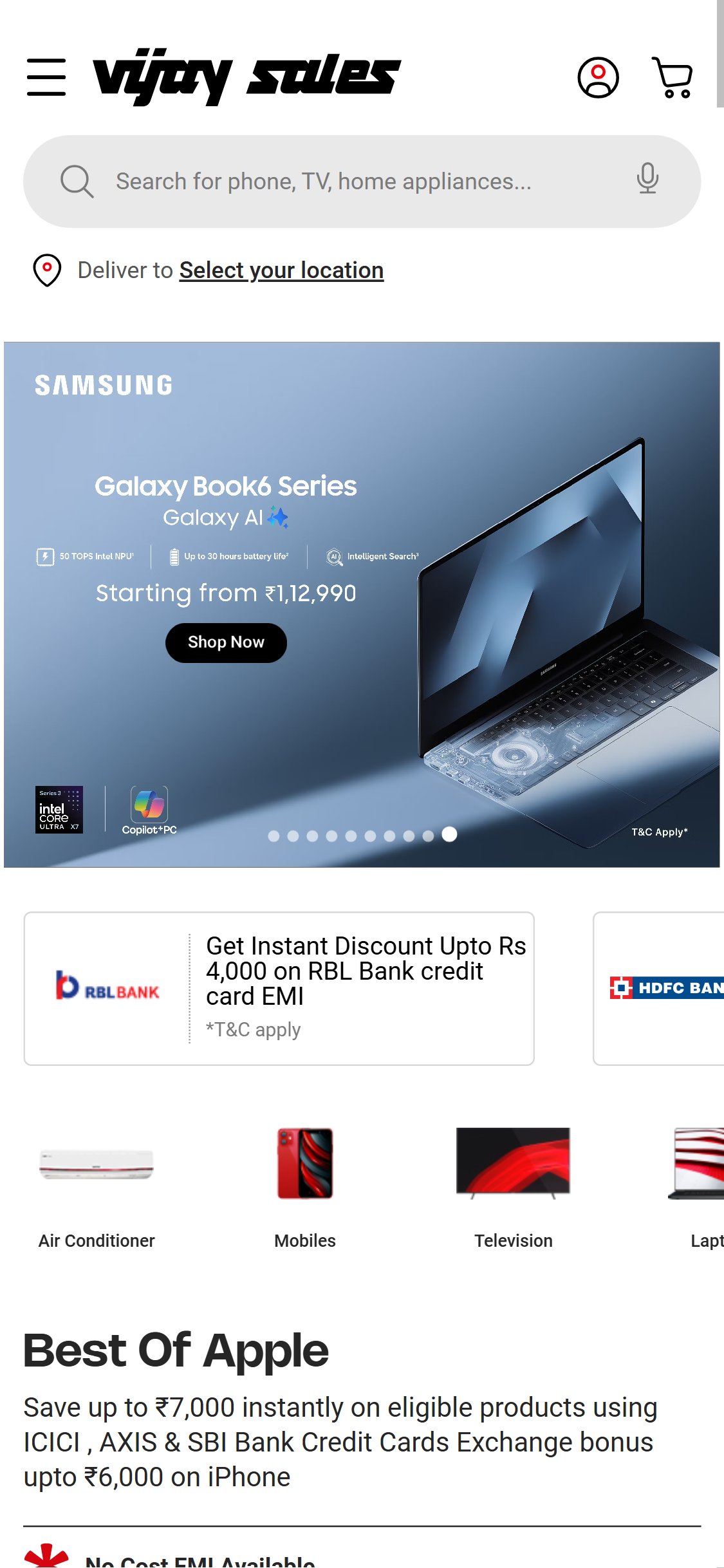
- The homepage loads with a hero carousel directly below the sticky header — there is no announcement bar surfacing live offers, EMI details, or free delivery thresholds.
- The hero slide does show EMI bank logos (Axis, ICICI, SBI) and cashback copy in small print, but this is buried inside the hero and not persistently visible as the user scrolls.
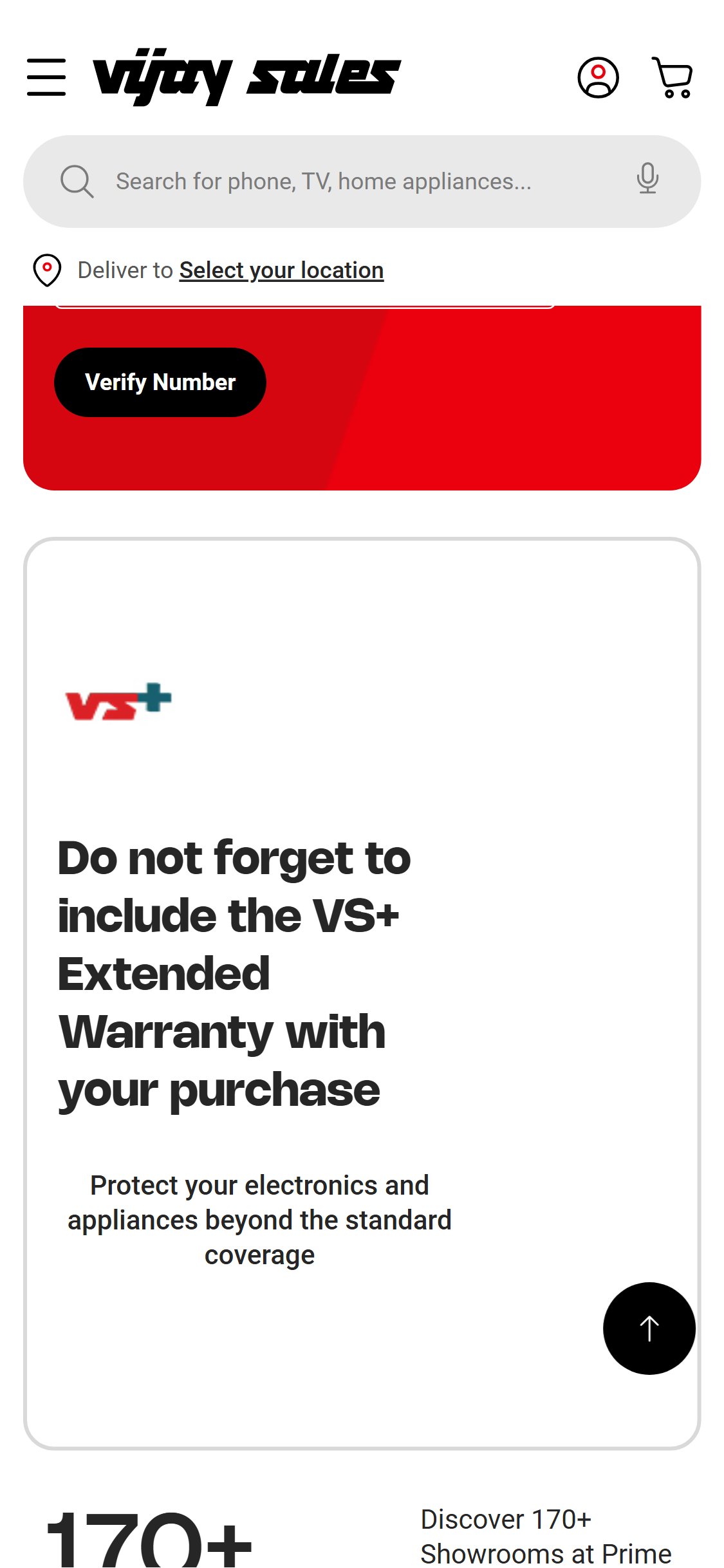
- Competitor electronics stores (Croma, Vijay Sales) keep a slim top bar visible at all times — typically surfacing bank offer codes, no-cost EMI range, or current sale deadlines.
- For high-AOV Apple products (₹64K–₹1.3L), surfacing 'No Cost EMI up to 24 months' persistently reduces purchase anxiety and has been shown to improve ATC rates by 8–12% in electronics.
- Add a slim (40px) sticky announcement bar above the header showing the single most compelling offer — e.g. 'No Cost EMI up to 24 months | Bank offers up to ₹4,000 off'.
- Rotate 2–3 messages: current bank offer, free delivery, and exchange/trade-in program (Limitless Exchange) — each as a scrolling ticker or tappable link.
- Use a high-contrast background (black or deep teal) so the bar is visually distinct from the dark header.
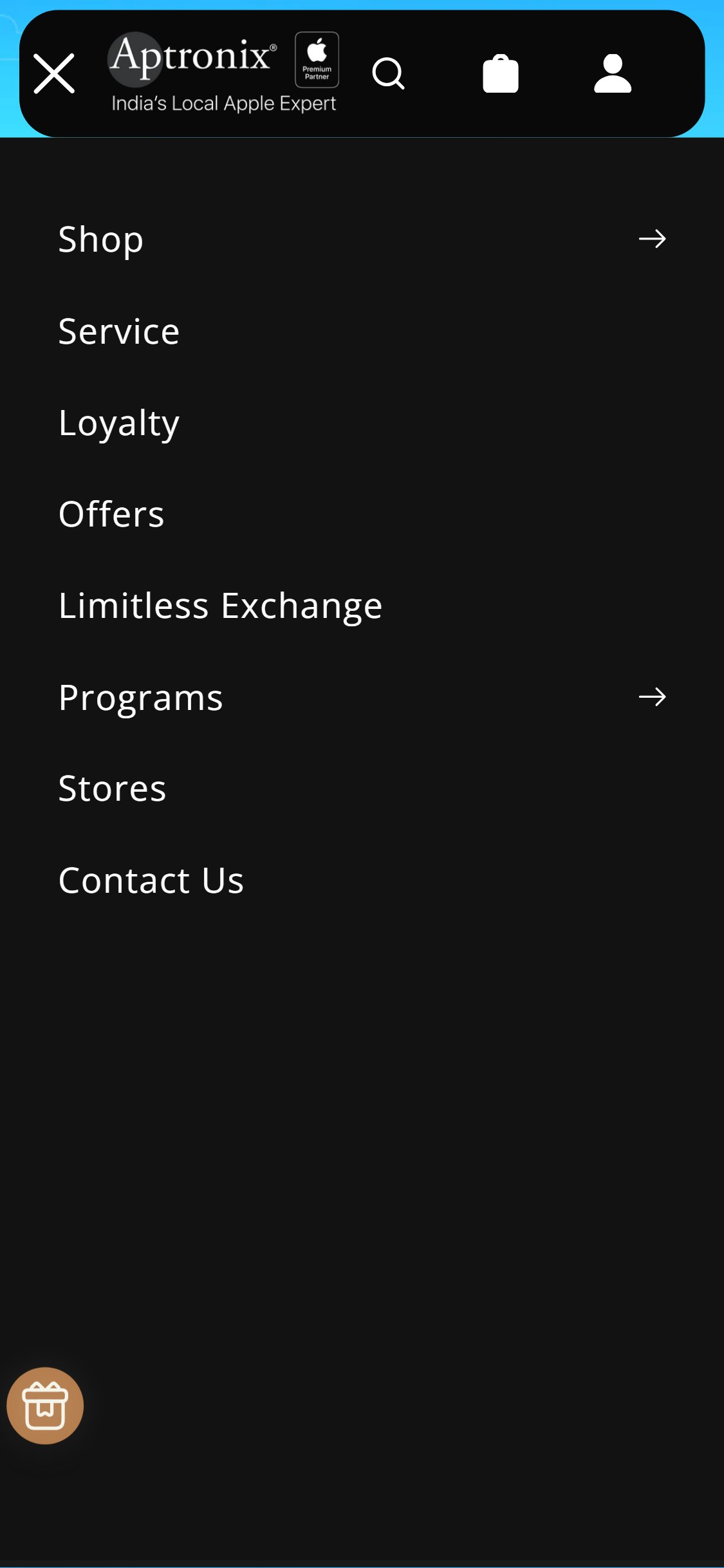
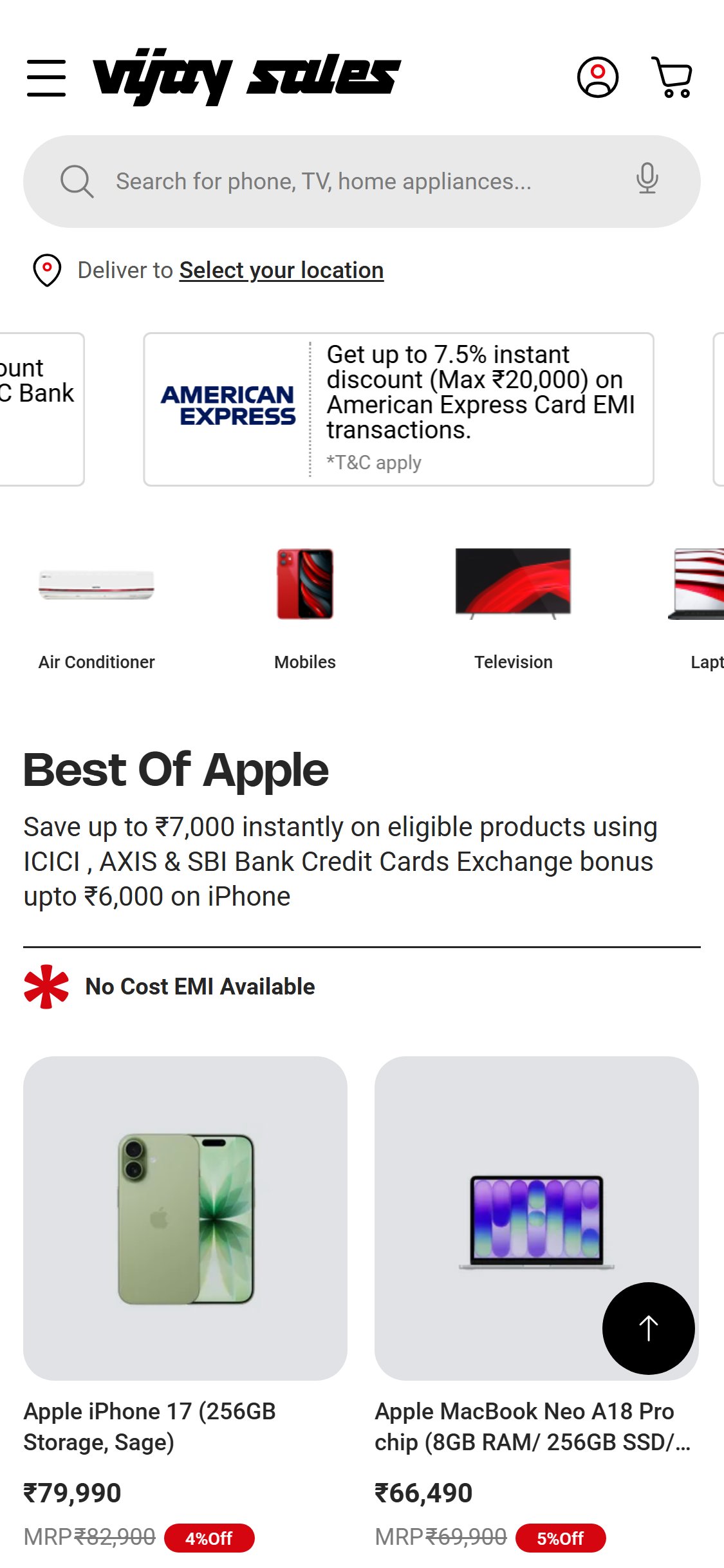
- The mobile header contains only: hamburger (≡), logo, search, cart, and account icons. There is no horizontal category scroll strip or quick-access category tiles visible on the homepage without opening the menu.
- When the hamburger is tapped, users see a full-screen overlay listing: Shop, Service, Loyalty, Offers, Limitless Exchange, Programs, Stores, Contact Us — with product categories (iPhone, iPad, Mac, Watch, TV & Home, AirPods, Accessories) nested one level deeper inside 'Shop →'.
- This means a new visitor landing on the homepage needs at minimum 2 taps to reach any product category — a significant friction point.
- Benchmark electronics retailers surface category chips or a horizontal scroll strip directly on the homepage, eliminating the navigation step entirely.
- The 'Shop by Category' section below the hero carousel does show category tiles, but this is halfway down the page and not always visible above the fold.
- Add a horizontal-scroll category strip directly below the hero — showing: iPhone, iPad, Mac, Watch, AirPods, Accessories — as icon+label chips. This mirrors Apple.com and Croma's mobile experience.
- Alternatively, surface the top 4–5 product categories as tappable image tiles in a 2×2 or scroll grid immediately below the hero (above the fold on most phones).
- Keep the hamburger menu for secondary nav (Service, Loyalty, Stores) — it should not be the primary product navigation on mobile.
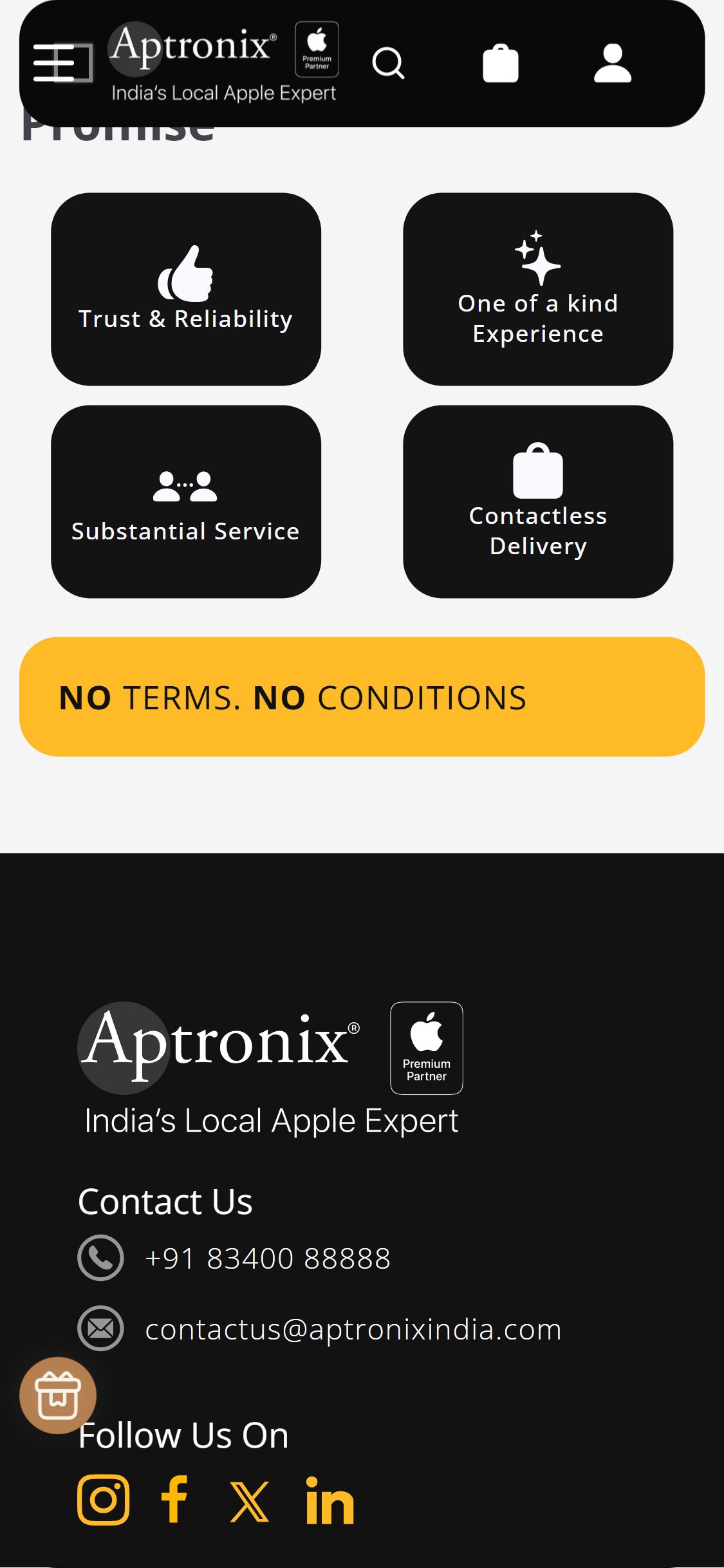
- The 'Aptronix Promise' section shows 4 black tiles: Trust & Reliability, One of a Kind Experience, Substantial Service, Contactless Delivery — each with a minimal icon and label only.
- None of the tiles include a specific claim — e.g. '1-Year Warranty', '7-Day Returns', 'Genuine Apple Products Only', or 'Same-Day Delivery in Mumbai'. These specifics are what build purchase confidence.
- The tile design (dark background, small icons) is visually consistent with the brand but functionally weak — it tells visitors what Aptronix values, not what they can actually expect.
- For a premium Apple reseller with AOVs of ₹65K–₹1.3L, trust signals must be concrete and verifiable. Vague promise language is a significant friction point for first-time buyers.
- Rewrite each tile with a specific, verifiable claim: 'Genuine Apple Products — Every device is 100% authentic' / '7-Day Easy Returns — No questions asked' / 'Apple-Trained Technicians — 100+ certified staff' / 'Same-Day Dispatch — Orders before 2 PM'.
- Add a brief sub-label (1 line) below each tile heading to substantiate the claim.
- Consider adding a 5th tile for Apple Premium Partner certification — this is a strong trust signal unique to Aptronix vs. grey-market resellers.


- The iPhone collection page shows product cards with color swatches, product name, 'Starting From' price, and a strikethrough MRP where applicable (e.g. iPhone 17: ₹80,400 with ₹82,900 strikethrough).
- However, there is no discount percentage badge (e.g. '3% OFF') or savings amount badge (e.g. 'Save ₹2,500') displayed prominently on the card.
- In Indian electronics retail, MRP strikethrough + discount % badge is present on 5/10 benchmark stores. Even small % discounts (2–5%) are surfaced prominently because they signal 'you're getting a deal over MRP'.
- iPhone 17e (₹64,900) shows no strikethrough at all — it's unclear if this is because no savings apply or because the display logic is inconsistent.
- Without a visual savings indicator, deal-conscious Indian buyers scanning the collection page have less motivation to click through to a PDP.
- Add a pill-shaped discount badge (e.g. '3% OFF' or 'Save ₹2,500') in the top-left corner of product card images for all SKUs where current price < MRP.
- For products with bank-specific offers (e.g. ₹4,000 additional off with ICICI), consider a secondary 'Bank Offer Available' chip on the card.
- Ensure all products with available discounts show the MRP strikethrough consistently — cards without any price comparison look inconsistent next to those that do.

- The filter panel (accessible via the 'Filter' button at the bottom of the collection page) slides up as a bottom sheet with three filter categories: Price (min/max text inputs), Storage (128GB, 256GB, 512GB, 1TB, 2TB with counts), and Color.
- The panel has a close (×) button at the top right but no visible 'Apply Filters' or 'Show X Results' CTA button at the bottom.
- Without a clear apply CTA, users may be unsure if filter selections are applied immediately (live filtering) or require a confirmation tap — this ambiguity increases abandonment.
- The 'Filter' button at the bottom of the page shows a filter icon but no badge count indicating how many filters are currently active — making it impossible to tell at a glance if filters are applied.
- Price filter uses free-text Min/Max inputs rather than a range slider — text input is slower and more error-prone on mobile compared to a slider or preset price bands.
- Add a sticky 'Show X Results' CTA button at the bottom of the filter drawer that updates dynamically as filters are selected — this confirms results count and closes the panel in one tap.
- Show a numeric badge on the 'Filter' button (e.g. 'Filter (2)') when any filters are active, so users know their current state without reopening the panel.
- Replace the free-text price inputs with a dual-handle range slider or predefined price bands (e.g. 'Under ₹75K', '₹75K–₹1L', 'Above ₹1L') for faster mobile interaction.
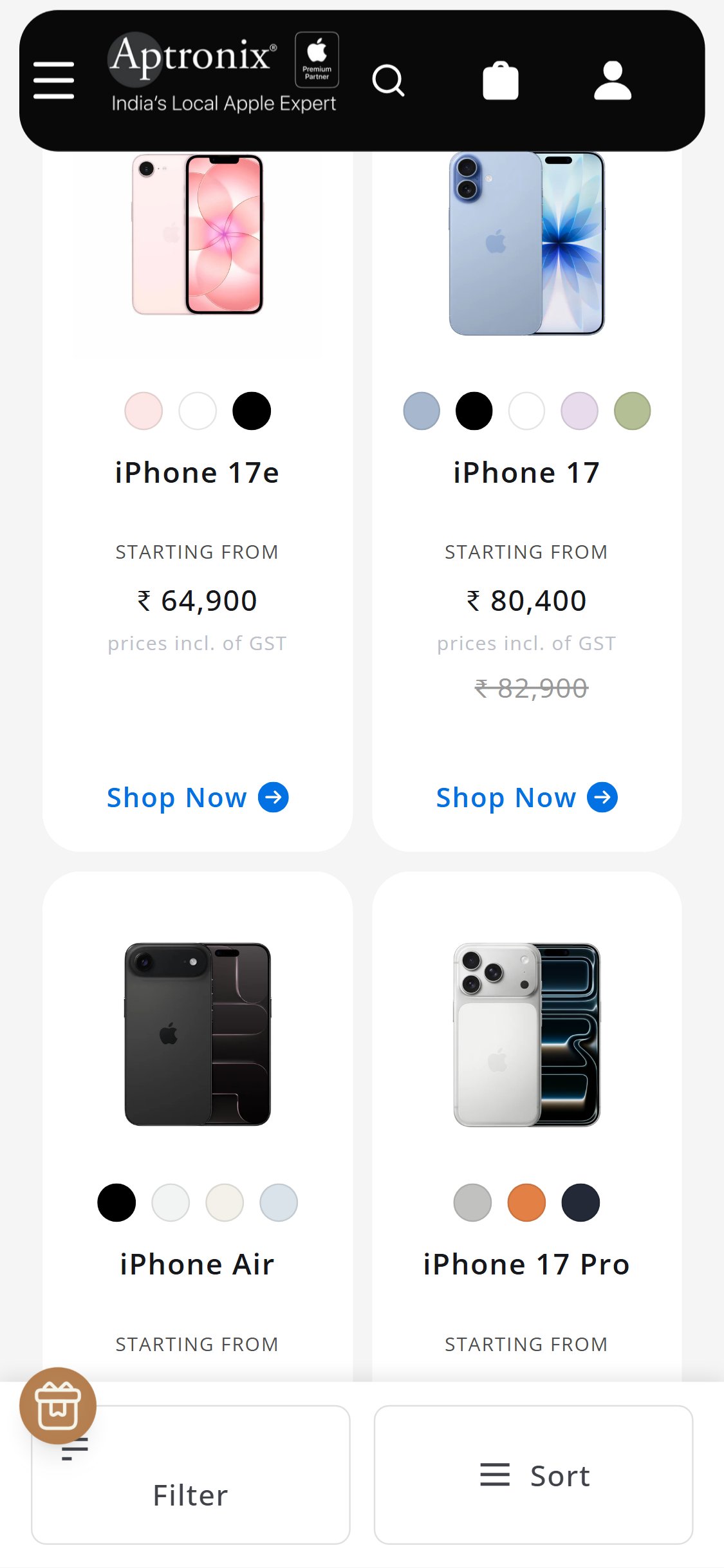
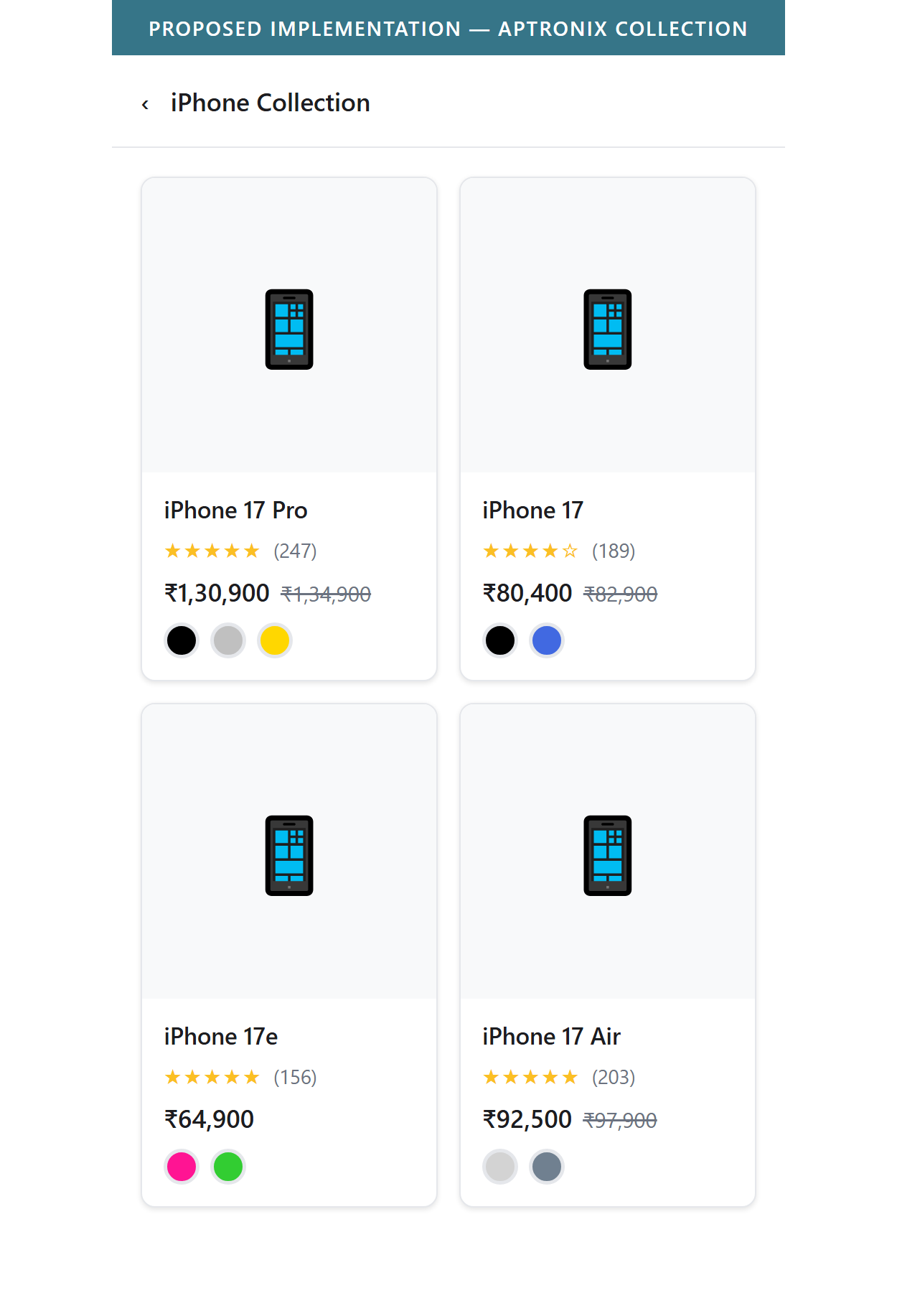
- Across all visible collection cards (iPhone 17e, iPhone 17, iPhone Air, iPhone 17 Pro), no star rating or review count is displayed below the product title.
- Star ratings on collection cards are present on 8/10 benchmark electronics stores. Even Apple's own resellers (Croma, iMagine) surface aggregate star ratings on category pages.
- The absence of ratings means all products look equally unvalidated. Users who rely on social proof to choose between models (e.g. iPhone 17 vs iPhone Air) have no on-page signal to guide their decision.
- Note: It is possible that Aptronix does not collect product reviews at all (no reviews app detected). If true, this is a compound issue — missing both the review collection infrastructure and the surface display.
- If product reviews are collected (e.g. via a reviews app), surface the aggregate star rating + review count (e.g. '★ 4.8 (124)') on each collection card below the product title.
- If reviews are not currently collected, implement a reviews app (Judge.me or Okendo) and seed initial reviews through post-purchase email flows before surfacing on collection pages.
- For Apple products specifically, Aptronix can optionally surface Apple's own ratings as a supplementary trust indicator (clearly labelled 'Apple rating').
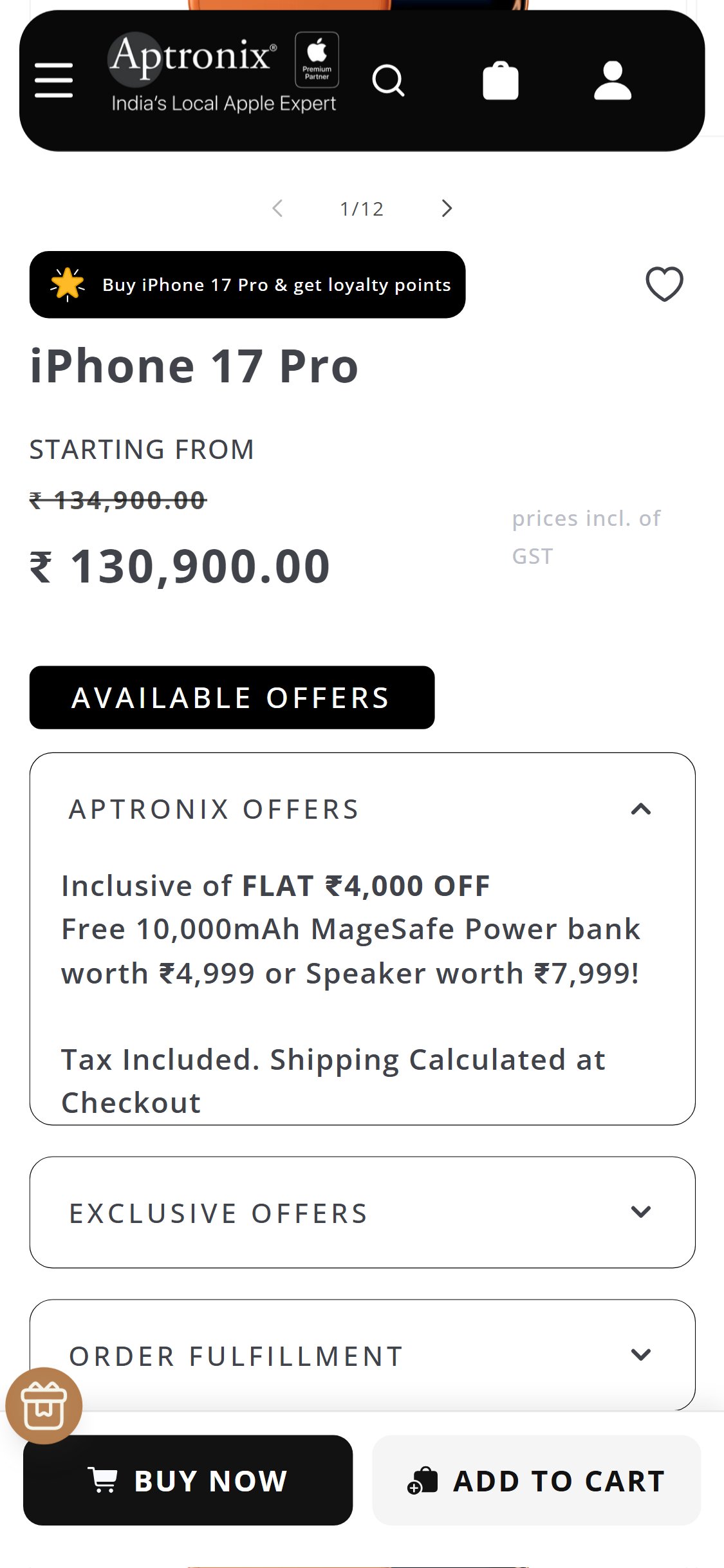
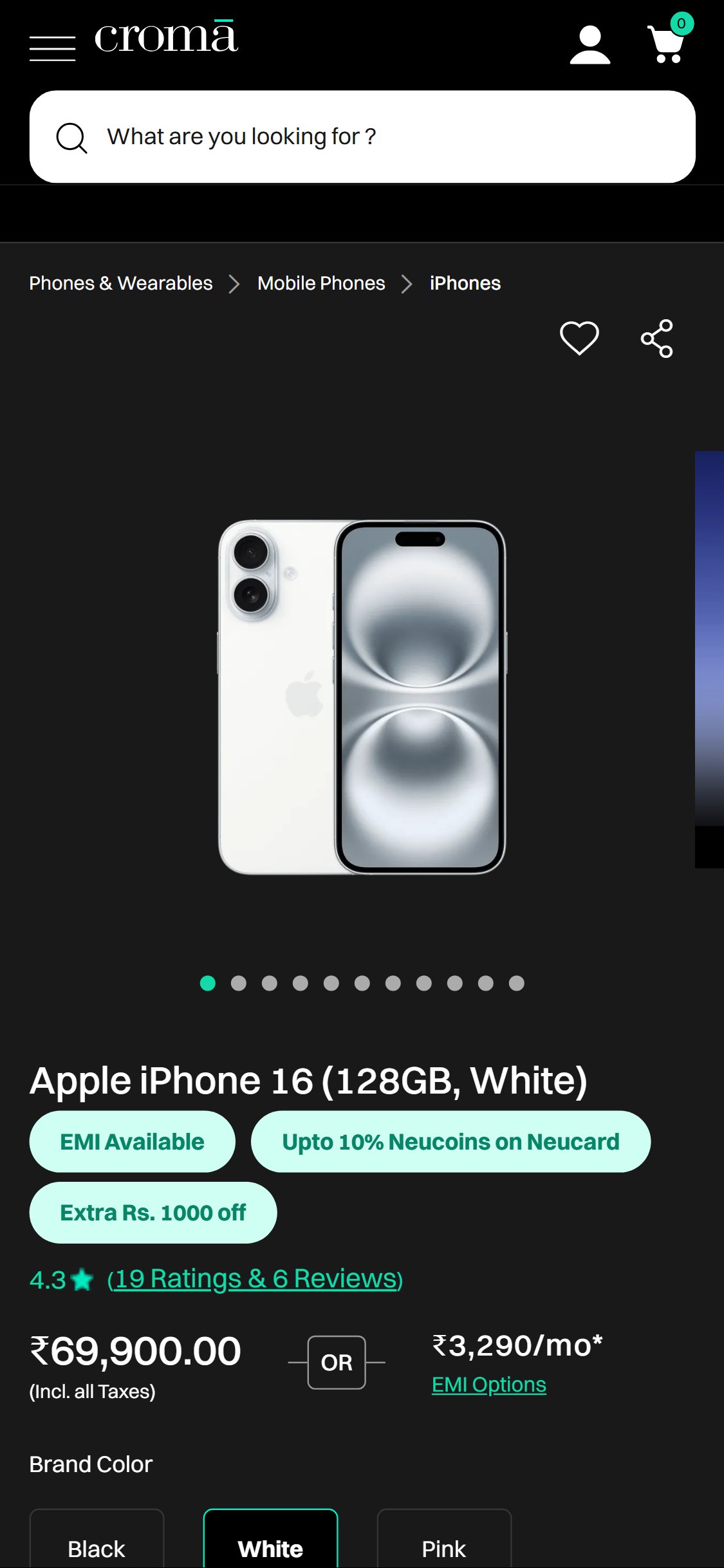
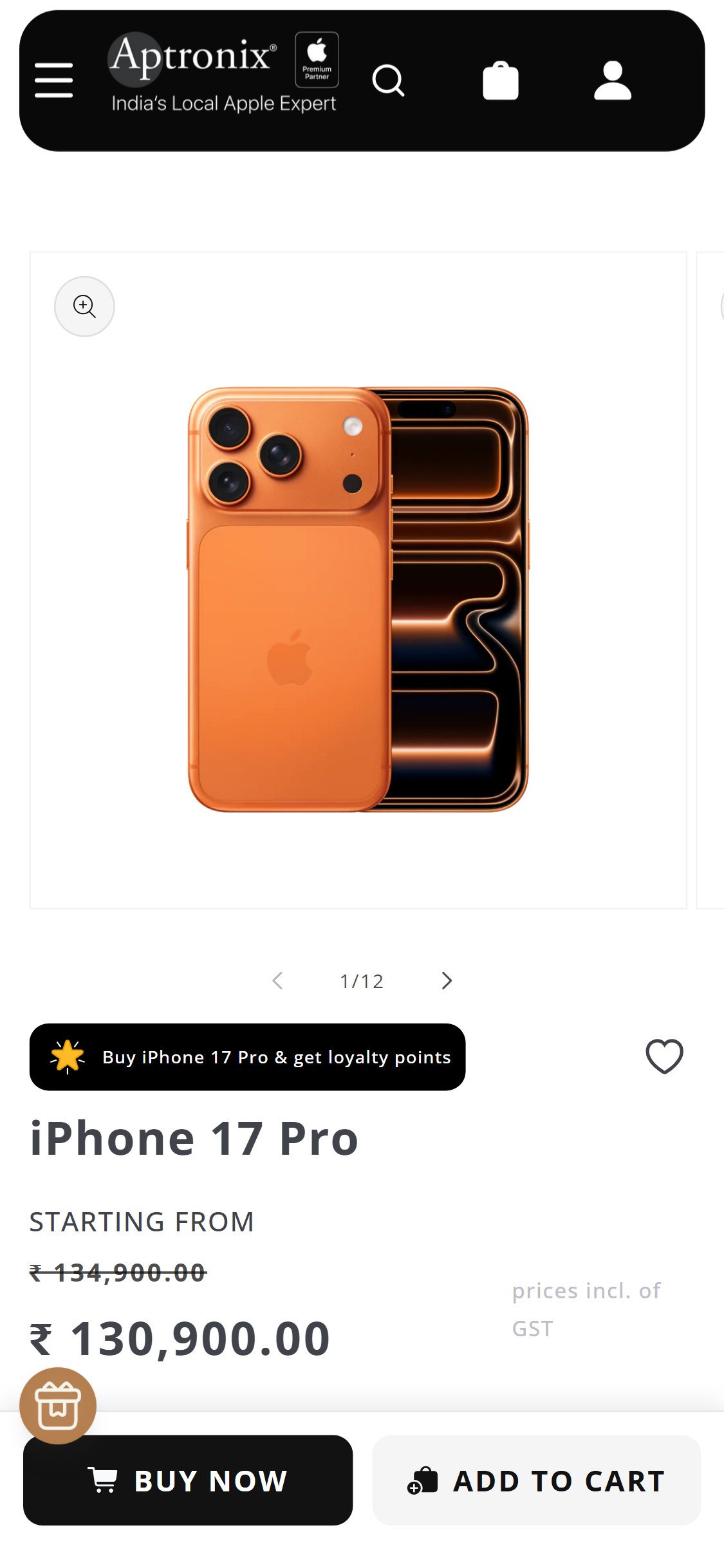
- The iPhone 17 Pro PDP shows: product image gallery (12 images), loyalty points badge ('Buy iPhone 17 Pro & get loyalty points'), product title, MRP strikethrough (₹134,900 → ₹130,900), and Available Offers accordion — but no star ratings anywhere in the above-the-fold ATC zone.
- The ATC zone (between product title and the BUY NOW / ADD TO CART buttons) contains no review stars, no review count, and no link to a reviews section.
- For ₹1.3L purchases, social proof from other buyers is a top-3 purchase driver. The absence of ratings in the highest-attention zone of the PDP is a material conversion gap.
- This is corroborated by the anti-pattern in benchmark_context.json: 'No reviews on PDP for non-cult brand — 15-20% CVR drop'. While Apple is a cult brand, Aptronix as a reseller benefits significantly from store-specific ratings ('Aptronix delivered fast and the device was genuine').
- Add aggregate star rating + review count directly below the product title (e.g. '★ 4.9 (247 reviews)') as a tappable link that scrolls to the reviews section.
- If no reviews app is currently installed, prioritise Judge.me or Okendo — both integrate natively with Shopify and support post-purchase email review requests.
- Seed reviews quickly via a post-purchase email sequence to existing customers before the feature goes live — a PDP with 0 reviews is worse than no reviews widget at all.
- The PDP ATC zone shows: loyalty badge, product title, MRP strikethrough price, Available Offers accordion (Aptronix Offers, Exclusive Offers, Order Fulfillment), and BUY NOW / ADD TO CART buttons.
- There is no dedicated EMI/instalment widget or 'No Cost EMI from ₹X/month' line near the price — a critical conversion element for high-AOV Indian electronics.
- The hero carousel on the homepage does surface EMI information ('No Cost EMI of up to 24 Months' with bank logos), but this is not surfaced on the PDP where the actual purchase decision is made.
- The 'Available Offers' accordion (expanded) shows 'Inclusive of Instant Cashback of upto ₹4,000' and 'Free 10,000mAh MageSafe Power bank worth ₹4,999 or Speaker worth ₹7,999' — but no EMI details are visible in the expanded panel.
- Industry benchmark: EMI/instalment display is present on 4/10 benchmark electronics stores, growing fast. For Apple resellers specifically (AOV ₹65K–₹1.3L), EMI display near the price is near-mandatory.
- Add a single-line EMI teaser directly below the product price: 'No Cost EMI from ₹5,454/month | 24-month plans available' — tappable to expand a full EMI calculator or bank-wise breakdown.
- Alternatively, add an EMI accordion inside the 'Available Offers' section or as a standalone 'EMI Options' expandable row.
- Surface bank-specific cashback codes (HDFC, ICICI, SBI, Axis) explicitly near the price — many Indian buyers hold multiple cards and will switch to the most beneficial one if prompted at the right moment.
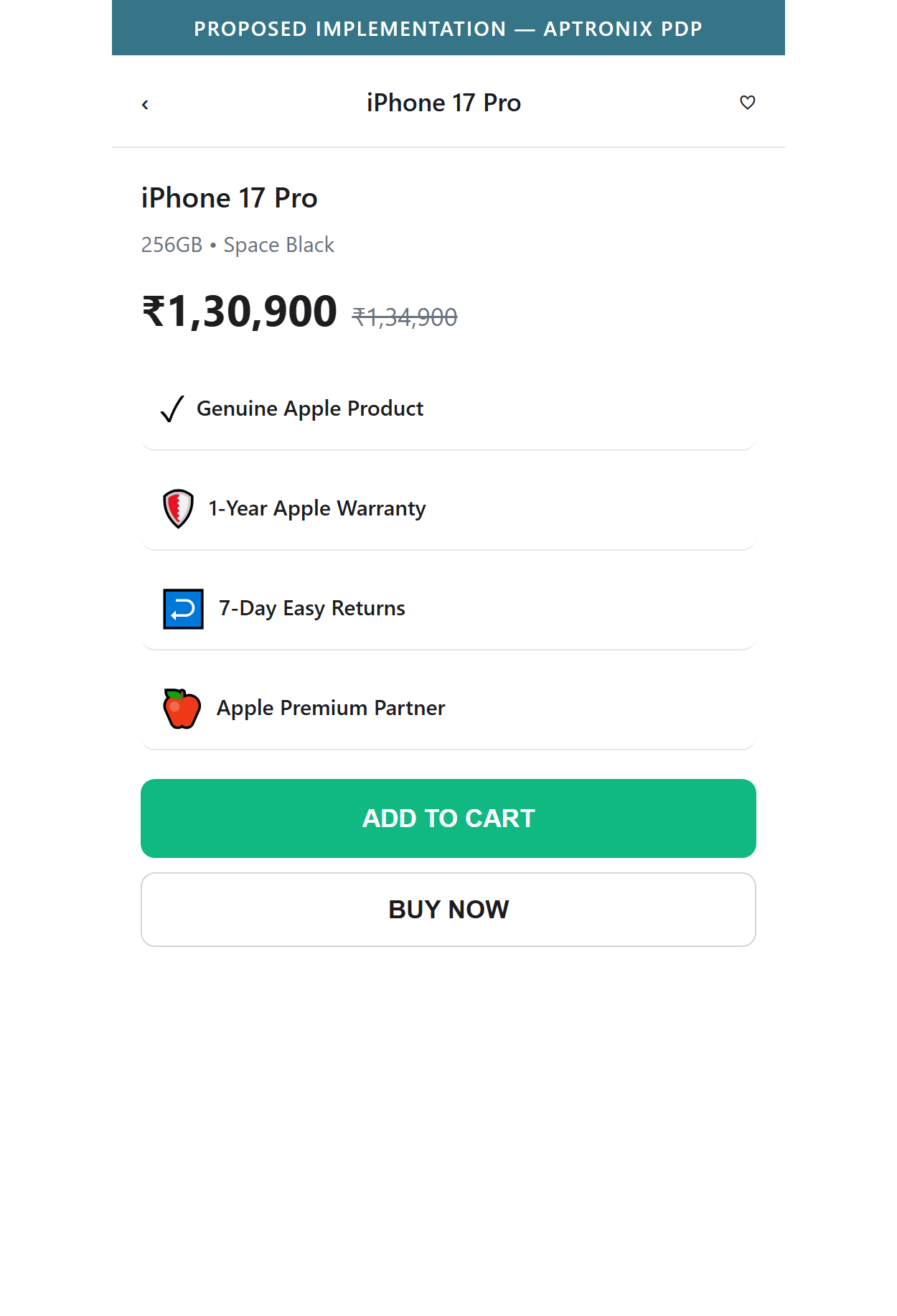
- Between the product price and the BUY NOW / ADD TO CART buttons, there are no inline trust badges — no 'Genuine Apple Product', no '1-Year Apple Warranty', no '7-Day Return' icon strip.
- The 'Aptronix Promise' section (Trust & Reliability, Substantial Service, Contactless Delivery) exists on the homepage but is not repeated on the PDP where it matters most.
- For a grey-market-saturated category like Apple devices, 'Genuine Apple Product' and 'Apple Premium Partner' trust signals at the point of purchase decision are especially critical. Buyers are acutely aware of counterfeit/refurbished risks.
- The Available Offers section partially addresses this ('Tax Included, Shipping Calculated at Checkout') but does not surface the most important trust claims (genuineness, warranty, returns).
- Add a 3–4 icon trust strip between the price and the ATC button: 'Genuine Apple Product | 1-Year Apple Warranty | 7-Day Returns | Apple Premium Partner'.
- Use recognisable iconography (checkmark, shield, return arrow, Apple Partner logo) rather than text alone — icons are processed faster on mobile.
- Link 'Apple Premium Partner' badge to the official Apple reseller verification page for maximum credibility.
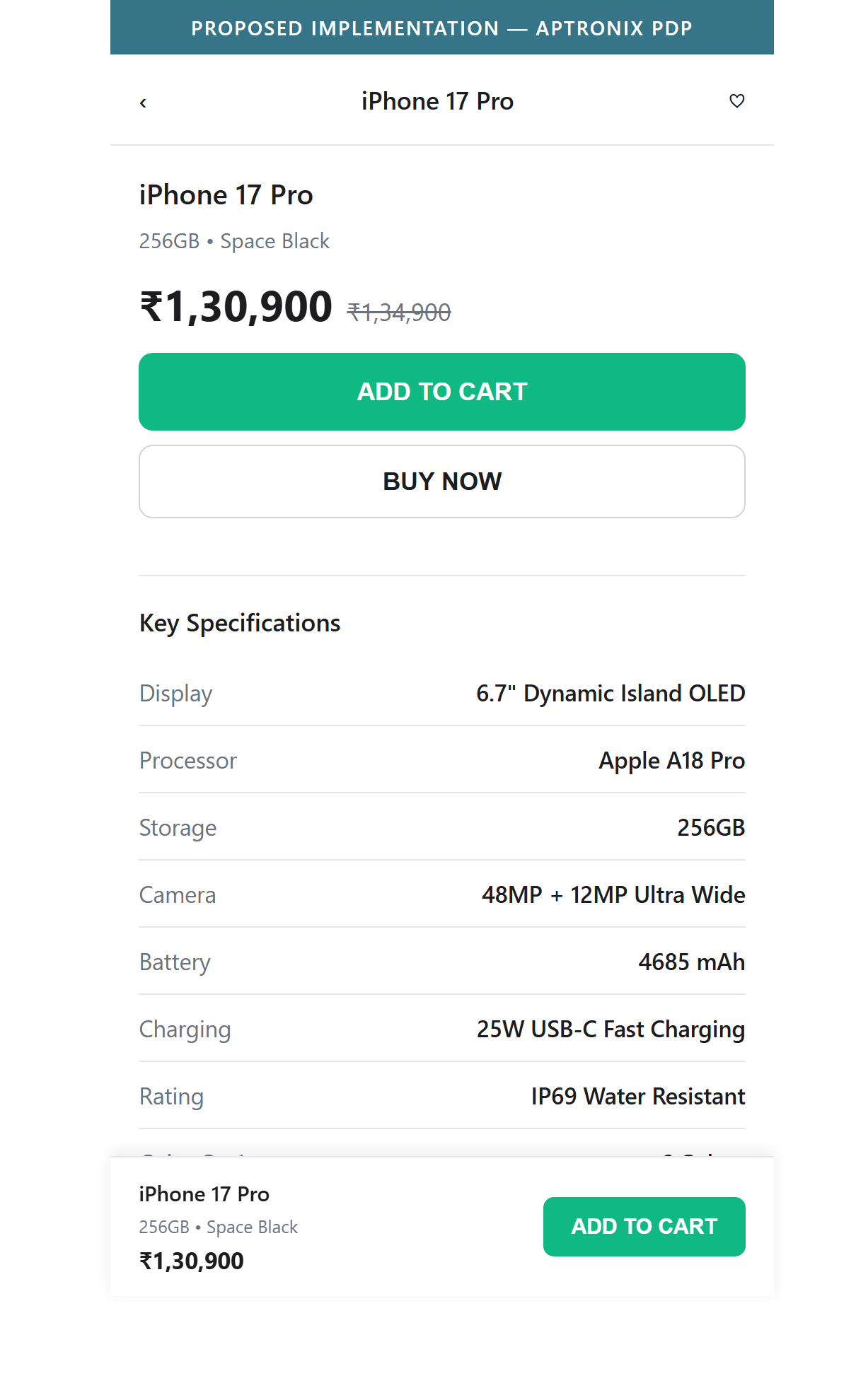
- The PDP has a BUY NOW and ADD TO CART button pair visible in the above-the-fold zone. However, as the user scrolls down to read specs, offers, or compare variants, these buttons scroll out of view.
- There is no sticky/floating ATC bar that persists at the bottom of the screen during scroll — a feature present on 3/10 benchmark electronics stores and growing.
- For long PDPs (which Apple product pages typically are — specs, compatibility, accessories), losing the ATC button from view increases cognitive load and reduces impulse-to-purchase conversions.
- The BUY NOW + ADD TO CART dual-CTA layout is a strong pattern — a sticky version would amplify its effectiveness significantly.
- Implement a sticky bottom bar that appears once the user scrolls past the above-the-fold ATC buttons — showing: product name (truncated), selected variant, price, and an ADD TO CART button.
- The bar should disappear when the user scrolls back up to the native ATC zone to avoid redundancy.
- Ensure the sticky bar respects the pincode-check flow (standard in India electronics — do not flag as anti-pattern) — the sticky bar can trigger the same pincode modal.
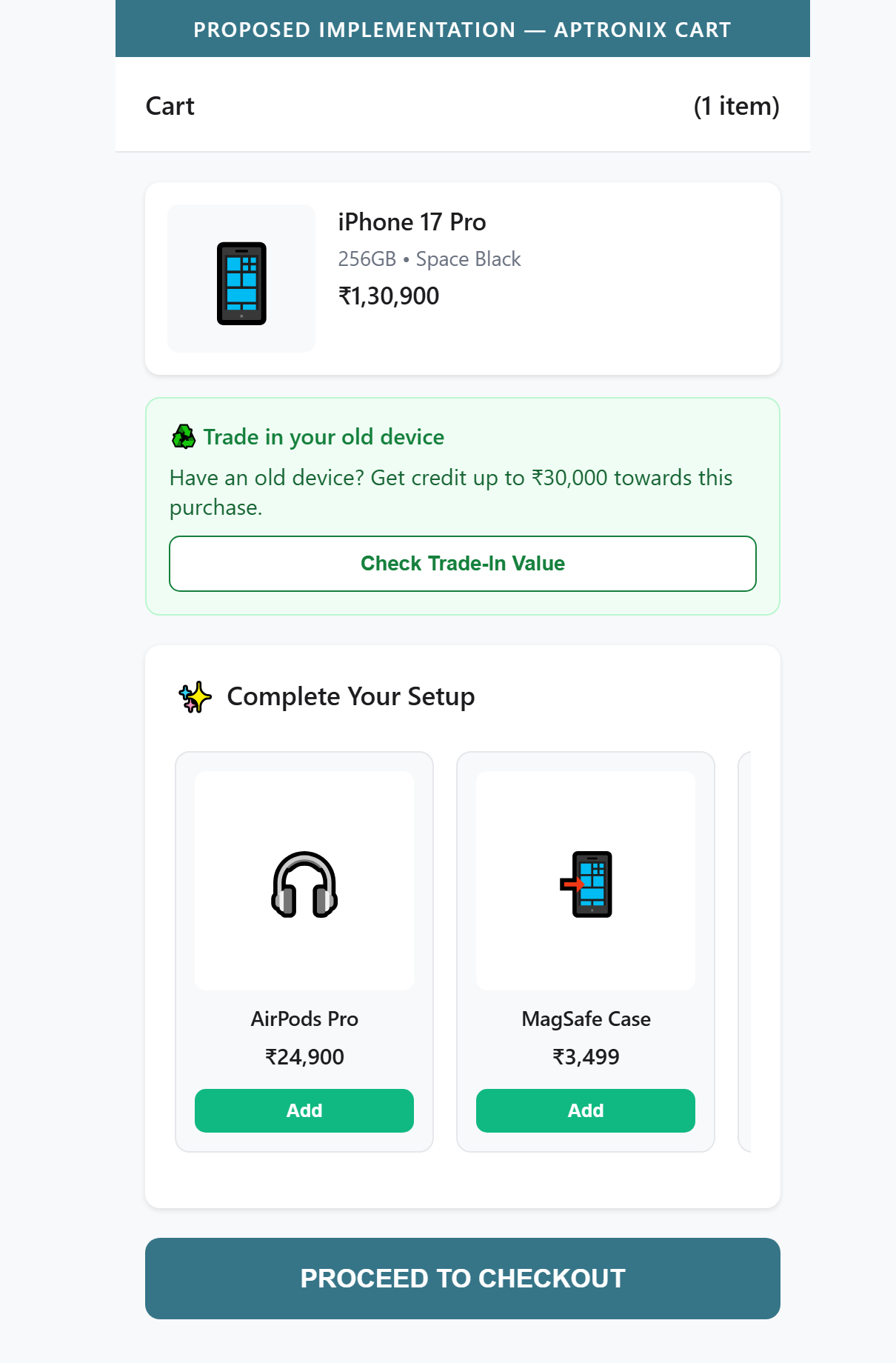
- Based on site audit and page source analysis, no cart upsell widget, 'Frequently Bought Together', or 'You May Also Like' section was detected on the cart page.
- No Rebuy, Bold Upsell, AfterSell, or similar upsell app script tags were identified during the audit.
- For an Apple premium reseller, the cart upsell opportunity is exceptionally high — a customer adding an iPhone 17 Pro (₹1.3L) is the ideal candidate to be upsold an Apple Watch, AirPods, MagSafe case, or AppleCare.
- Accessory attach rate is a primary margin driver for Apple resellers. Croma and iMagine both surface 'Complete Your Setup' or 'Recommended Accessories' sections in the cart flow.
- Aptronix's own Limitless Exchange program is also not surfaced in the cart — a missed opportunity to remind customers they can fund part of their new purchase via device trade-in.
- Add a 'Complete Your Setup' horizontal scroll section in the cart showing 3–4 compatible accessories (case, AirPods, Apple Watch band, MagSafe charger) based on the cart's main product category.
- Use a dedicated upsell app (Rebuy, ReConvert, or AfterSell) to power personalised cross-sells — these typically lift cart value by 8–15% in electronics.
- Surface the Limitless Exchange (trade-in) program as a cart banner: 'Have an old device? Trade it in and save up to ₹X on your order.'
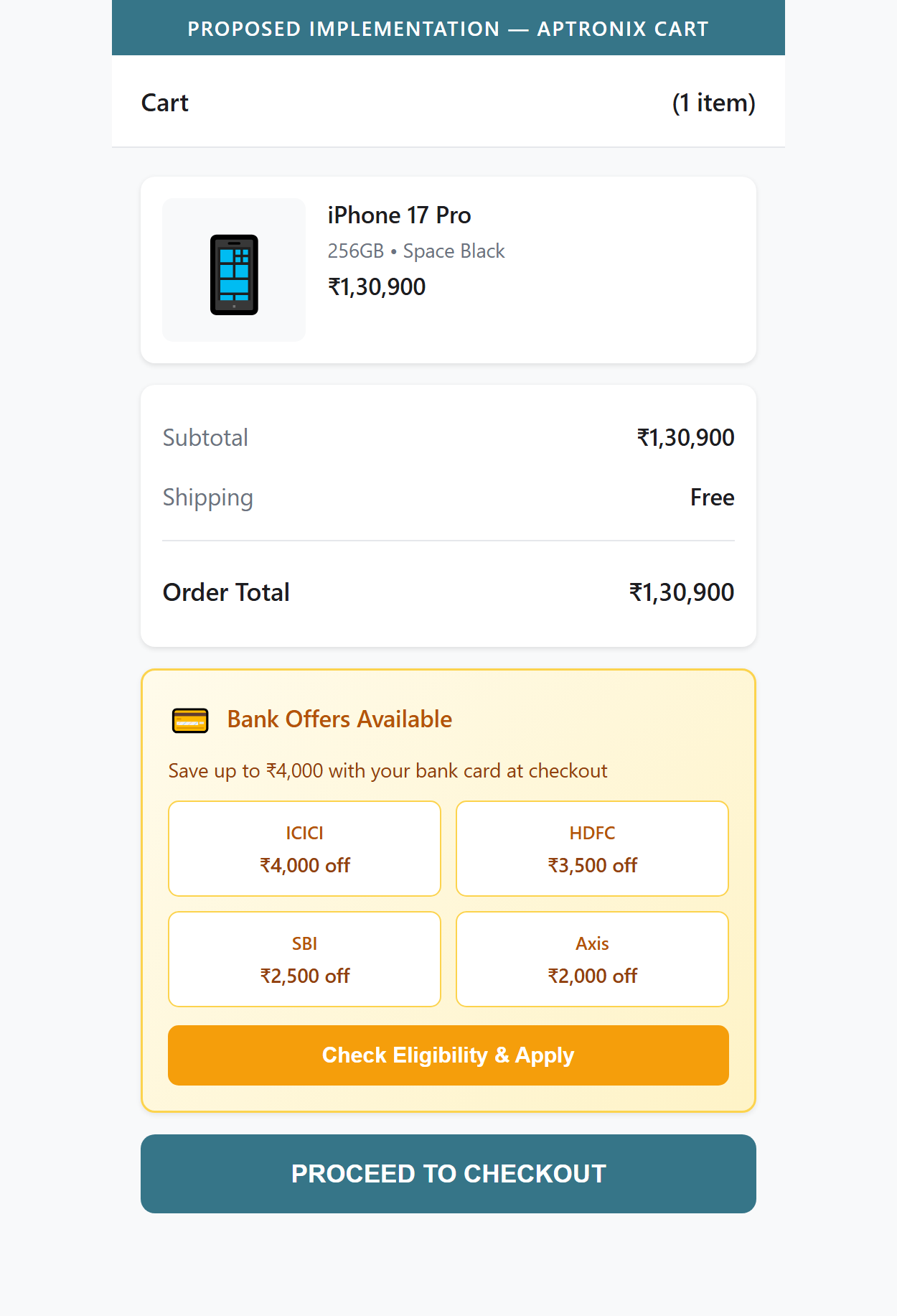
- The homepage hero prominently features 'Inclusive of Instant Cashback of upto ₹4,000' with logos for Axis Bank, ICICI Bank, and SBI Card — plus 'No Cost EMI of upto 24 Months' with multiple bank logos.
- However, bank-specific offer codes are typically only redeemable at checkout via a coupon code field. If the cart page does not remind users of these codes (or auto-applies them), buyers who don't remember the code will miss the savings.
- Surfacing a 'You may be eligible for a ₹4,000 instant cashback — enter your bank card type to check' prompt in the cart is a strong India-specific conversion driver.
- This pattern is emerging among premium Indian electronics resellers as a trust/savings reinforcement mechanism.
- Add a 'Bank Offers Available' banner in the cart listing the eligible banks (Axis, ICICI, SBI, HDFC) with a CTA to 'Check eligibility' or 'Apply at checkout'.
- If possible, implement auto-detection — detect the card type entered at checkout and auto-apply the relevant cashback code.
- At minimum, display a reminder: 'Use code ICICI4000 at checkout for ₹4,000 off with ICICI Bank cards' — even a static reminder reduces the drop-off from customers who forgot the code.
Performance & Technology
Core Web Vitals, page-speed signals, and the technology stack powering Aptronix India
Core Web Vitals
Technology Stack
Performance & Technology Assessment
Mobile performance is needs work (46/100); desktop is needs work (67/100) on Shopify. Page-speed and Core Web Vitals are increasingly load-bearing for SEO and conversion in this category — addressing the weakest vital first is the single highest-leverage technical improvement available.
Confidential — Prepared for Aptronix India by Growisto | May 2026
App Ecosystem
What's installed vs what's missing from best-in-class Electronics stores
Present (4)
Missing (5)
App Stack Assessment
Aptronix has invested in differentiating loyalty and exchange programs — these are genuine competitive advantages vs. generic electronics retailers. However, the conversion stack has critical gaps: no product reviews app means PDPs lack social proof entirely, no EMI widget means high-AOV purchase anxiety is not addressed at the point of decision, and no cart upsell means the accessory attach opportunity is left on the table at every checkout. These three missing apps represent the highest-ROI technology investments available to Aptronix.
Confidential — Prepared for Aptronix India by Growisto | May 2026